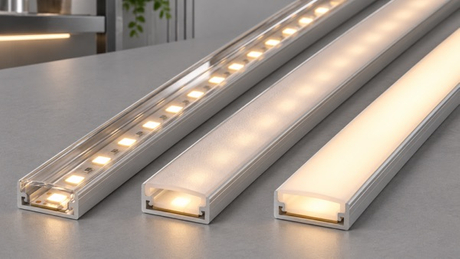
Quick answer: choose a clear cover when maximum light output and a sharper beam matter more than hiding LED points; choose a frosted cover when you need a practical balance between transmission, visual comfort and moderate diffusion; choose an opal or milky cover when the priority is a softer, more uniform luminous line. The best choice cannot be made from the cover name alone. LED spacing, strip-to-cover distance, profile geometry, viewing angle, surface finish and required illuminance must be evaluated as one optical system.
This guide is written for lighting designers, architects, electrical contractors, shopfitters, sign and display manufacturers, distributors and OEM buyers specifying LED strip with aluminum profiles. It focuses on the questions that matter before a sample is approved: Will the LEDs be visible? How much useful light remains? Is the line comfortable from the normal viewing position? Will the cover change the appearance of white or coloured light? Can the same result be repeated along the complete installation?
An LED profile cover is often treated as a finishing accessory. In practice, it is an optical component. It changes how light leaves the aluminum channel, how bright the emitting surface appears, how strongly individual LEDs are visible and how the luminaire looks when switched off.
The LED strip, aluminum profile and diffuser therefore should not be purchased as three independent parts. They form one assembly. A high-density strip can still show bright spots in a shallow profile. A deep profile can produce a smooth line with a lower-density strip, but it may be too large for the recess. A very opaque cover can hide points while also reducing the useful illuminance at the target surface. These are system trade-offs, not defects that one component can solve alone.
Before selecting a cover, define four project outcomes:
the required light level on the task, shelf, wall or architectural surface;
whether the luminous line is directly visible to occupants;
how uniform the line must appear from the real viewing distance;
the maximum external profile size allowed by the detail.
If these outcomes are not stated, “clear”, “frosted” and “opal” become subjective labels rather than useful specifications.
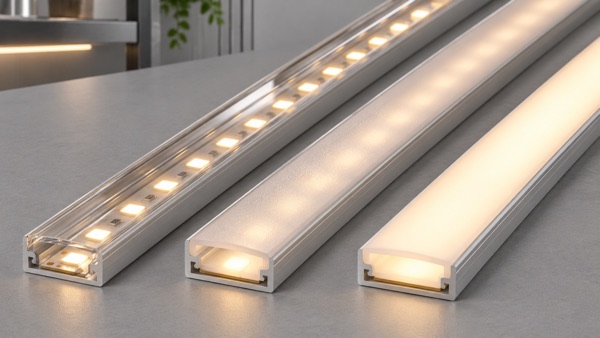
A clear cover protects the LED strip while changing the beam less than a diffusing cover. It normally delivers the highest transmission of the three categories, but it also reveals more of the internal assembly. LED points, solder joints, printed circuit colour and small installation variations may remain visible.
Clear covers are most suitable when the profile is hidden from normal view, when the light is aimed at another surface, or when preserving peak output is more important than creating a continuous luminous line. Examples include concealed shelf lighting, indirect cove lighting and task lighting where the viewer sees the illuminated work surface rather than the profile aperture.
A frosted cover scatters light through a textured or diffusing material. It softens LED points and widens the apparent emitting surface while usually retaining more directional character than a heavily opal cover. This makes it a common compromise for under-cabinet lighting, retail shelves, joinery and general linear accent lighting.
“Frosted” is not a universal optical grade. Two suppliers may use the same word for covers with different haze, transmission and surface finish. A procurement specification should therefore reference an approved physical sample or an agreed optical result, not the adjective alone.
An opal cover contains or uses a stronger diffusing effect to spread light through the material. It can create a wider, softer luminous surface and reduce the contrast between bright LED locations and darker gaps. This is often preferred for visible architectural lines, decorative profiles, reception areas and installations viewed at short distance.
The trade-off is that stronger diffusion normally reduces direct transmission and may lower the measured illuminance compared with a clear cover on the same strip. That does not automatically make opal inefficient: if the design goal is visual comfort and a clean luminous line, the optical distribution may be more useful even when peak intensity is lower.
| Decision factor | Clear | Frosted | Opal / milky |
|---|---|---|---|
| Primary goal | Preserve output and beam definition | Balance output and diffusion | Prioritise uniformity and softer appearance |
| Visibility of LED points | Highest | Reduced | Lowest, if geometry is suitable |
| Typical viewing condition | Profile concealed or viewed indirectly | Occasionally or obliquely visible | Directly visible luminous line |
| Peak illuminance with the same strip | Generally highest | Intermediate | Generally lower and more spread |
| Optical tolerance to lower LED density | Low | Medium | Higher, but not unlimited |
| Common risk | Visible points and internal details | Assuming all frosted covers behave alike | Losing too much task light or still seeing hotspots in a shallow profile |
This table is a starting point. Final selection should be made with the actual LED strip, profile and cover assembled at the intended operating level.
Diffusion needs physical distance. Light from adjacent LEDs must overlap before it reaches the cover. When the cover sits very close to the LED packages, each LED creates a local bright area. Increasing opacity can reduce the contrast, but there is a limit: a very shallow profile may still show points while wasting more light.
This is why the internal optical depth of the profile matters more than the external height alone. The relevant dimension is the distance from the emitting surface of the LED to the underside of the diffuser. The shape of the profile walls, the cover curvature and the position of the strip also influence mixing.
For projects that require a dot-free line, evaluate profile depth together with LED density and diffuser type. Our related guide explains this system relationship in more detail: LED Strip Density and Aluminum Profile Depth.
Closer LED spacing reduces the dark gap that the diffuser must bridge. Smaller packages can also reduce the size of each bright point. COB LED strip uses many closely spaced emitting elements under a continuous phosphor layer, so it often produces a smoother line in compact profiles than a widely spaced SMD strip.
However, COB does not make profile optics irrelevant. A very shallow channel can reveal brightness variation, edge effects or the strip’s central line. A wider cover may also need more lateral mixing than a narrow strip can provide. The correct question is not “Does COB need a diffuser?” but “What cover and profile geometry produces the required emitting surface with this specific strip?”
Where the installation must bend or the luminous surface itself becomes a visible architectural element, LED neon flex may be a better optical format. See COB LED Strip vs LED Neon Flex for the system-level comparison.
Glare is not determined by total lumens alone. A small, very bright aperture can feel uncomfortable even when the overall light level is moderate. A diffuser increases the apparent emitting area and lowers local luminance contrast, which can make a visible linear luminaire more comfortable.
But a milky cover is not a guarantee of low glare. If the profile is located in the direct field of view, if the emitting surface remains very bright, or if the installation creates reflections on glossy materials, discomfort may continue. Recessing the profile, changing its aiming direction, increasing the emitting area or lowering operating intensity may be more effective than changing only the cover.
For retail shelves and work surfaces, distinguish between two goals:
source comfort: how the luminous profile looks to the eye;
task performance: how much light reaches the merchandise or working plane.
A good design meets both. An opal cover may improve source comfort, while a clear or lightly frosted cover may deliver more task light. The correct balance depends on viewing geometry.
A clear cover tends to preserve the profile’s original beam shape. A diffusing cover redistributes light into a wider range of angles. This can soften scallops and improve surface uniformity at short distances, but it can also reduce peak illuminance at the centre of the beam.
Do not compare covers only by holding them in front of the eye. Measure the assembled system at the actual target distance. For a shelf, record illuminance across the front, centre and rear. For a wall wash, inspect vertical uniformity and edge transitions. For a visible line, photograph it at fixed exposure from the expected viewing positions.
If the project is specified by lumens, watts and lux, use the system output after the cover—not the bare-strip output—as the decision value. The relationship between these quantities is explained in LED Strip Brightness Explained.
Any optical material can influence spectral transmission and perceived colour. The effect may be small, but it becomes important when multiple profile types, cover batches or installation details must match within one project. The cover can also change perceived colour indirectly by altering luminance and the amount of surrounding reflection.
For white-light projects, compare assembled samples rather than relying only on the LED strip’s nominal CCT and CRI. For RGB or tunable-white systems, check saturated colours, intermediate mixes and low-level dimming. A cover that looks neutral with warm white may reveal a different appearance with blue or mixed light.
Keep the diffuser material, surface finish and production reference consistent across areas that must visually match. For a broader colour-quality specification, see LED Strip Color Quality: CCT, CRI, R9, TM-30 and SDCM.
Use clear or lightly frosted when task illuminance is the priority and the profile is screened by the cabinet edge. Use stronger diffusion when the source is visible from seated or standing positions. Test reflections on polished counters, glass shelves and packaged products.
Frosted covers are often a useful starting point because they soften the source while retaining useful punch on merchandise. For jewellery, cosmetics or glossy products, inspect reflections from the customer’s normal position. An opal line may look cleaner but can require a different strip output or spacing plan to maintain target illuminance.
If the LED profile is fully concealed, a clear cover can preserve output and provide physical protection. A diffuser may still help when the throw distance is short or the illuminated surface reveals scalloping. The receiving surface, setback and aiming angle usually have more influence than the cover alone.
Opal is a common starting point for continuous visible lines, but the profile must provide enough mixing depth. Check joints, end caps and corners because a smooth centre section can still show dark interruptions at mechanical connections.
Consider both optical and mechanical exposure. A cover selected for appearance must also suit the profile design and installation environment. Do not assume that a diffuser name determines load resistance, ingress protection or suitability for walking surfaces. Those requirements need separate confirmed product data.
Cover performance depends on material formulation, thickness, texture, extrusion quality and aging conditions. Names such as “milky”, “opal” and “semi-clear” are commercial descriptions, not globally standardised optical classes.
For repeatable procurement, record:
the approved cover sample or product reference;
the exact profile and LED strip used in approval;
the cover appearance when switched off;
the visual uniformity when switched on;
the measured light level at the defined target;
the viewing distance, angle and camera exposure used for comparison.
This is more reliable than accepting a generic description from a datasheet or quotation.
The diffuser changes the optical result, while the aluminum profile also contributes to mechanical support and heat management. The cover should not be used to compensate for excessive drive conditions or an unsuitable thermal design. Higher temperature can influence LED output, colour stability, adhesive performance and material appearance over time.
Evaluate the strip at the intended operating power inside the actual profile, not only as an open-air sample. The profile must suit the strip width and installation method, and the assembly needs a practical path for heat to leave. See LED Strip Thermal Management and Aluminum Profiles.
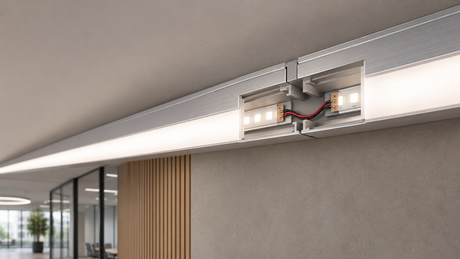
Diffuser selection is only one part of visual continuity. Dark zones often appear where covers meet, where profiles are cut, at connectors, or near end caps. These interruptions become more obvious in long visible lines.
Plan joint locations before cutting. Avoid placing a mechanical joint at a focal point when possible. Check whether the cover can run continuously across a profile joint, whether thermal expansion requires a gap, and whether the LED cut pitch allows the light source to extend close enough to the end. Do not promise a “seamless” result until the exact joint detail has been sampled.
A useful sample should reproduce the optical stack, not just provide a short piece of diffuser. Assemble at least the proposed LED strip, aluminum profile, cover, end treatment, power supply or control method and mounting condition.
Set the operating condition. Use the intended voltage, dimming level and thermal environment.
Observe from real positions. Check direct, oblique and reflected views at the expected distance.
Measure the task. Record illuminance or another agreed project metric at defined points.
Check uniformity. Inspect the centre, ends, joints, corners and any connector locations.
Check colour. Compare white light, dimmed states and colour mixes where applicable.
Document approval. Photograph with fixed exposure and record all component references.
This process turns a subjective “looks good” decision into a repeatable project standard.
To compare LED strips, profiles and diffusers efficiently, provide:
application and installation location;
whether the luminous line is directly visible;
available profile width and depth;
required strip width and light colour or control type;
target illuminance or visual effect;
run length, joint layout and corner details;
photos, drawings or section details;
preferred clear, frosted or opal appearance, if already defined.
Leomay supplies LED strips, COB LED strips, LED neon flex and LED aluminum profiles for global markets. Project-specific product availability, dimensions, performance and commercial conditions should be confirmed against the current quotation and approved sample.
A clear cover generally transmits more direct light than a frosted or opal cover, but the useful result depends on beam direction and the target surface. Compare complete assemblies at the project distance rather than comparing bare cover samples.
An opal cover often hides LED points better, but it cannot guarantee a dot-free line by itself. LED density, strip-to-cover distance, profile width, LED package size and viewing angle must work together.
Sometimes, especially in a deeper profile, but it must be sampled. If the LEDs are too far apart or too close to the cover, bright spots may remain even with strong diffusion.
No. COB usually provides a more continuous emitting surface, but shallow geometry, a wide aperture, edge effects or a visible central brightness band can still affect uniformity.
It normally reduces peak direct transmission compared with a clear cover and redistributes more light to wider angles. Whether that is a disadvantage depends on whether the project prioritises task illuminance, surface uniformity or visual comfort.
Frosted commonly describes a surface or material that moderately scatters light. Opal usually indicates stronger, more volumetric diffusion and a milkier appearance. These terms are not standardised, so approve the actual sample.
It can slightly influence spectral transmission and perceived colour. For projects with strict matching requirements, measure and approve the LED strip inside the final profile with the final cover.
Use clear or lightly frosted when maximum task light is needed and the source is concealed. Use stronger diffusion when occupants can see the aperture or when reflections make individual LEDs distracting.
There is no universal depth because LED pitch, package size, strip position, cover width and opacity differ. Specify the desired visual result, then validate the complete assembly from the actual viewing distance.
No. A diffuser approved with one strip may produce different brightness, colour appearance or uniformity with another density, package, width or power level. Re-test when a component in the optical stack changes.
Clear, frosted and opal covers solve different problems. Clear prioritises transmission, frosted balances transmission and diffusion, and opal prioritises a soft, uniform luminous surface. None is automatically “best”. The correct result comes from matching the cover with LED density, profile depth, viewing geometry, target illuminance and the project’s visual standard.
CTA: Send Leomay your application, section drawing, visible aperture, run length, target light effect and viewing condition. We can use that information to discuss a suitable LED strip, COB strip, neon flex or aluminum-profile assembly and define what should be verified in a project sample. Product details and commercial conditions remain subject to confirmation for the specific enquiry.