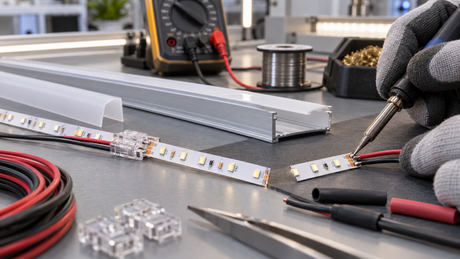
Direct answer: LED strip brightness should not be selected from watts per meter alone. Use lumens per meter to compare the strip's published light output, watts per meter to calculate electrical load, lumens per watt to understand luminous efficacy, and lux to verify how much light reaches the intended surface. The final result also depends on distance, mounting direction, aluminum profile, diffuser, surface reflectance, voltage at the strip, temperature, dimming level and the accuracy of the measurement data. For a commercial project, define the required visual task first, compare data under stated conditions, and validate a representative installed assembly.
This guide is intended for lighting designers, electrical engineers, fit-out contractors, sign and display manufacturers, distributors and B2B buyers selecting low-voltage LED strips for projects in Europe, North America and other markets. Their search intent is usually not simply “Which strip has the highest number?” They need to know whether a proposed strip can produce the required result after it is installed inside a profile, behind a diffuser and at a defined distance from the illuminated surface.
The same method applies to common applications such as cabinet and shelf lighting, coves, hospitality interiors, retail displays, reception desks, architectural details and linear fixtures. Each application can require a different balance of output, uniformity, glare control, color quality, power, heat management and service access.
Luminous flux is measured in lumens. For an LED strip, output is commonly expressed as lumens per meter (lm/m) or lumens per foot. It helps buyers compare how much visible light a defined length produces under the stated test conditions. The CIE defines the lumen as the SI unit of luminous flux. See the CIE definition of lumen.
Lumens per meter are more relevant to brightness than watts per meter, but the value still needs context. Ask whether it represents the bare strip, a complete profile assembly or another configuration. Also confirm the CCT, CRI, input voltage, operating temperature, measurement tolerance and whether the value is typical, minimum or nominal.
Watts per meter (W/m) describe the rated electrical input of a specific strip configuration. This value is used to calculate connected load, current, driver capacity, controller capacity, cable loading, voltage drop and thermal conditions. It does not directly state how much visible light reaches the space.
Two strips with the same W/m can produce different lm/m because LED packages, spectra, drive current, circuit design and thermal conditions differ. Two strips with the same lm/m can also require different input power. Treat W/m as an electrical design input rather than a universal brightness or quality score.
Luminous efficacy is calculated as light output divided by electrical power:
Luminous efficacy (lm/W) = luminous flux (lm) ÷ input power (W)
The U.S. Department of Energy explains that LED source efficacy and complete-fixture efficacy are different because drivers, optics and thermal design affect the delivered result. See DOE LED Basics. When comparing strip data, confirm whether the calculation refers to the LED package, bare strip or installed system.
Illuminance is measured in lux (lx), equal to lumens per square meter. Lux addresses the project question that strip-output data alone cannot answer: how much light reaches the worktop, merchandise, wall, floor or other target surface? The NIST Guide to the SI lists lux as the SI unit of illuminance.
There is no reliable universal conversion from lm/m to lux without the installation geometry and light distribution. Distance, angle, diffuser, profile, shielding, surrounding surfaces and the size of the illuminated area all affect the result.
| Metric | What it helps you decide — and what it does not prove |
|---|---|
| lm/m | Compares published light output per unit length. It does not prove the illuminance on the target surface or the output after profile and diffuser losses. |
| W/m | Supports power, current, driver, cable and thermal planning. It is not a direct measurement of brightness. |
| lm/W | Describes luminous efficacy for the defined measurement boundary. It does not prove suitable distribution, glare control, color quality or application performance. |
| lux | Measures illuminance at a specific point or plane. It depends on geometry and does not by itself describe total output, uniformity or visual comfort. |
A strip close to a shelf can create high local illuminance over a narrow area, while the same strip mounted farther away spreads light over a larger area and produces a different lux reading. Direct, indirect, grazing and cove installations cannot be compared using lm/m alone.
An aluminum profile can support mounting, alignment and thermal management. A diffuser can improve visual uniformity and reduce direct view of individual LEDs, but optical transmission and beam distribution depend on the selected profile and cover. Request data or test the intended combination instead of subtracting one assumed percentage from every system.
A light-colored matte surface can return more useful light than a dark or highly absorbing surface. Glossy materials may create reflections or glare even when the lux level appears adequate. Retail merchandise, stone, timber, fabrics and painted walls should be evaluated in the actual material palette.
Voltage drop can reduce output toward the far end of a run. Elevated operating temperature can change LED performance. Dimming level and control method also affect the measured result. Review the LED strip voltage-drop and power-supply sizing guide when the project uses long runs, remote drivers or multiple feed points.
Do not begin with a generic “bright,” “high output” or W/m description. Begin with the visual task and the installation drawing.
Define the purpose. Is the strip decorative, an accent, a wall wash, shelf lighting, a task light or part of the general lighting?
Identify the target plane. State where illuminance matters and the distance from the strip to that plane.
Describe the geometry. Include recess depth, profile orientation, diffuser, shielding and nearby surfaces.
Set visual priorities. Output, uniformity, glare, dot-free appearance, color quality and efficiency can require trade-offs.
Use a lighting calculation when needed. For regulated, task-critical or larger projects, use suitable photometric data and a professional lighting calculation.
Validate a representative assembly. Measure and visually review the intended strip, profile, diffuser, driver and control combination.
There is no single correct lm/m value for every cove, cabinet, retail shelf or hotel detail. The requirement depends on the target illuminance, surrounding light, geometry, materials and project criteria.
Not necessarily. LED density can influence visual continuity, spacing and how easily a diffuser hides individual points. Total output also depends on the LED package, drive current, circuit design, power and thermal conditions. A high-density strip operated at a lower current can be less bright than a lower-density strip using a different package and electrical design.
Use LED count together with lm/m, W/m, strip width, cutting interval, CCT, CRI, voltage and the intended profile. If a continuous line is the main objective, compare the complete optical assembly rather than assuming the highest LED count is automatically best.
Neither construction is universally brighter. COB strips are often considered when a continuous luminous line and compact optical appearance are important. SMD strips offer many package, density and color-configuration options. Output and efficacy remain model-specific.
Compare the actual data and representative samples. For the wider selection decision, read COB vs SMD LED Strip for Commercial Projects.
Assume a hypothetical strip is listed at 1,000 lm/m and the project uses 5 m. The simple source-output estimate is:
1,000 lm/m × 5 m = 5,000 lm
This does not mean 5,000 lumens arrive at the work surface. Optical transmission, distribution, shielding, distance, surface reflectance, temperature, voltage and measurement tolerance affect the delivered result. It also does not prove uniformity or glare performance. This example explains the arithmetic only and is not a Leomay product specification or a recommended application value.
Compare the same length unit and convert lm/ft and lm/m consistently.
Confirm whether the value is measured, calculated, typical, minimum or nominal.
Check the CCT and CRI configuration; different spectra can affect efficacy.
Confirm input voltage, W/m and the operating point used for the test.
Ask whether the output is for the bare strip or a profile-and-diffuser assembly.
Review tolerance, temperature and stabilization conditions.
For multi-channel strips, confirm which channels were operating during measurement.
Do not compare an LED-package efficacy value directly with complete-system efficacy.
A technically credible comparison states the measurement boundary. If two suppliers use different boundaries, the numbers may not represent the same product condition.
Build a sample using the intended strip, profile, diffuser, driver, controller, feed arrangement and mounting surface. Operate it under a relevant load and allow the output to stabilize before comparison. Measure lux at documented points on the target plane, but also inspect uniformity, glare, shadows, color appearance and visible gradients.
For repeated spaces or long continuous lines, compare multiple lengths or reels where appropriate. Record the sample configuration so that the approved result can be referenced during procurement and installation. The validation plan should follow the project specification and applicable professional requirements rather than one universal test distance.
European project documents commonly use metric units such as lm/m, W/m and lux. North American documents may also use lumens per foot and foot-candles. State both units when several project teams will use the same specification, and identify the measurement plane and geometry.
Required electrical, safety, EMC, energy, location and performance documentation depends on the selected model, completed system and destination market. Certification documentation availability must be confirmed for the selected product model and target market; brightness data alone does not establish compliance.
For an efficient quotation or sample review, provide:
Application and target market
Installation drawing, section detail or site photo
Decorative, accent, task or general-lighting purpose
Target illuminance or other project criterion, if defined
Distance and orientation to the target surface
Preferred strip type, width, voltage and run length
Required CCT, CRI and color-consistency criteria
Profile, diffuser and dot-free appearance requirement
Dimming or control method
Indoor or outdoor environment and IP requirement
Quantity range and required certification documents
You can review current LED strip product options as a starting point, then confirm the selected model and project conditions.
No. W/m describes electrical input. Brightness is better compared using light-output data such as lm/m, while the result on a surface is evaluated in lux under defined installation conditions.
There is no universal value. Define the application, target plane, distance, optics, surrounding light and project criteria, then use calculations and a representative sample to select an appropriate output.
No. Density affects spacing and continuity, but total output depends on the LED package, drive current, circuit, power and thermal design. Compare measured lm/m and the complete assembly.
Not reliably without geometry and distribution information. Lux depends on where the light lands, distance, angle, diffuser, profile, shielding and surface conditions.
A diffuser changes optical transmission and distribution. The amount depends on its material, finish, thickness and profile geometry. Test or request data for the intended combination rather than applying one universal loss value.
Yes. CCT, spectrum, CRI, SDCM, diffuser, distribution, viewing angle, temperature, dimming and surrounding materials can change the perceived result.
Not automatically. COB and SMD describe different constructions; brightness and efficacy depend on the selected model and operating conditions.
Send the application, drawing, target surface, distance, required lighting effect, voltage, dimensions, CCT, CRI, profile and diffuser, control method, environment, quantity range, target market and required documents.
The strongest LED strip specification connects source output, electrical load and the real installation. Use lm/m to compare published strip output, W/m for electrical planning, lm/W for efficacy and lux for the illuminated surface. Then verify the chosen profile, diffuser, driver, controls, wiring and thermal conditions as one representative system.
Planning a commercial LED strip project? Send Leomay the application, installation drawing, target surface and distance, preferred strip dimensions and voltage, required light effect, CCT, CRI, profile and diffuser, dimming method, environment, quantity range, target market and required certification documentation. Leomay can review relevant product options and documentation availability for the selected model and project.