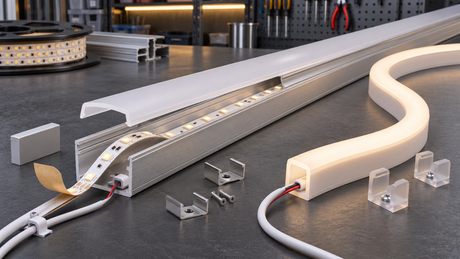
LED Strip and Aluminum Profile Compatibility: How to Specify a Complete Linear Lighting Assembly
Direct answer: Specify a linear lighting assembly, not a strip alone. Match the selected LED strip, COB strip or silicone neon flex with the aluminum profile or sleeve, diffuser, thermal path, wiring, controller and mounting method. Check exact dimensions, bend direction, cable entry and service access before sampling.
Who Needs This Compatibility Guide?
This guide supports lighting designers, electrical installers, system integrators, sign and display fabricators, distributors and OEM procurement teams working on global projects, including Europe and North America. The selected model and project documents remain the source of truth.
Start With the Complete Compatibility Chain
Map the chain before comparing price: application and viewing distance; LED strip, COB strip or silicone neon flex; aluminum profile, diffuser or neon sleeve; power supply, controller and cable route; mounting surface, thermal path and service access; exposure conditions and target-market documents. A change at one point can affect the rest.
What Must Match Between a Strip and a Profile?
Width and height
Compare actual strip width and component height with the usable internal width and depth of the profile. Do not rely on a nominal “10 mm” channel name. Clips, lenses, adhesive surfaces and internal clearances differ by model. Confirm the cross-section drawing for the exact combination.
Light-emitting position
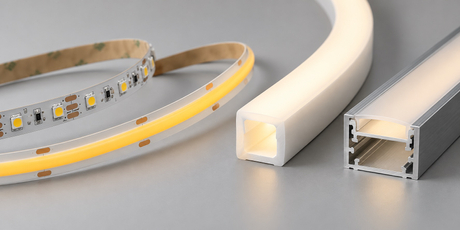
LED position affects diffuser distance and the risk of visible dots or scalloping. COB strip may be selected for a smoother luminous line, but it still requires a compatible depth, diffuser and viewing geometry. A conventional strip may need a different optical distance.
Connection and service space
Allow space for the power lead, connector, end treatment and bend radius without crushing the strip. A profile can fit the light source while failing at the end cap or cable exit. Include real termination parts in the sample.
COB Strip, LED Strip or Neon Flex?
Flexible LED strip: useful as a flexible linear source inside a suitable channel or protected mounting method; check width, bend direction and thermal contact.
COB LED strip: often considered for a continuous-looking line; confirm the selected construction, profile depth, diffuser and installation conditions.
Silicone neon flex: uses a shaped silicone body and dedicated mounting method. Match cross-section, bend direction, cut position, end treatment and cable entry; do not treat it as a bare strip with a generic cover.
Review Leomay LED strip product options and digital strip options by exact model when a project requires a particular profile, control system or termination method.
How to Choose the Profile and Diffuser
Profile geometry
Choose based on mounting surface, visible flange, access, desired line width and the selected cross-section. Recessed, surface, corner and suspended arrangements create different visual and service constraints. Compare profile and light-source drawings at the same scale.
Diffuser and visual target
A diffuser can soften points, alter line width and redistribute visible output. The result depends on LED spacing, lens distance, viewing angle and brightness target. Approve a representative assembly instead of selecting only by catalogue label.
Thermal path
An aluminum profile can provide a heat-spreading path when strip, adhesive interface and installation method are suitable. It does not automatically make every installation thermally adequate. Confirm contact, surface preparation, profile continuity and surrounding airflow.
Electrical and Control Compatibility
Confirm input voltage, polarity, connected load, run lengths, feed points and controller output. A physically fitting connector may still be electrically unsuitable. For longer runs, consult the voltage drop and power supply sizing guide, then verify exact model data.
For dimming, RGB, RGBW or addressable products, map channels and cable routes before installation. Review LED controller options by model and control method.
Indoor, Damp and Outdoor Assembly Checks
Exposure conditions apply to the complete installation. Check strip or neon body, connectors, end caps, cable entries, profile, power-supply location and sealing method together. An aluminum channel does not automatically change ingress protection. Use the LED strip IP ratings guide to frame questions, then confirm the selected model and project requirements.
Representative Assembly Validation
Before volume quotation, build a sample with the real strip or neon model, profile, diffuser, connector, end cap, cable entry, power supply and control method. Inspect continuous appearance, mechanical retention, cable routing, service access, thermal contact, control response and fit after cutting or joining. Record the approved model, revision, cross-section and installation notes.
Common Compatibility Failures
The strip fits but the diffuser does not
Internal clips, lens geometry or strip height can prevent closure. Recheck usable depth and the complete cross-section.
The line looks uneven
Possible causes include spacing, insufficient optical distance, wrong diffuser, reflections, joins or inconsistent mounting. Compare a complete assembly.
The end is difficult to terminate
Connector bodies, cable exits and end caps need planned space. Include them in drawings and samples.
The installation runs hot or lifts
Review adhesive preparation, profile contact, continuity, operating conditions and selected-model guidance. Do not infer thermal suitability from appearance.
Quotation and Sampling Checklist
Send the supplier: application and viewing distance; strip, COB or neon format; cross-section, width, height and bend direction; voltage, color or CCT, CRI and control method; run lengths, feed points and cable entry; profile type, internal dimensions and diffuser preference; exposure and mounting surface; quantity range, drawings, sample requirements and required documents.
Frequently Asked Questions
Can any LED strip fit any aluminum profile?
No. Width, height, light-emitting position, connector clearance and diffuser geometry must match exact models.
How do I choose profile width and depth?
Start with the selected cross-section and required optical distance, then confirm usable internal dimensions in the profile drawing.
Is COB strip always better inside a channel?
No. COB can support a smooth appearance, but profile, diffuser, heat path and viewing conditions still determine suitability.
Can silicone neon flex use a standard strip channel?
Only when the channel and mounting method are designed for that cross-section. Check bend direction, retention, cut position and end treatment.
Does a diffuser change brightness and appearance?
Yes. It can soften points and change apparent line, output and viewing result. Approve the complete assembly.
Should I match the profile to voltage or dimensions?
Both matter. The profile is primarily a mechanical and optical match; voltage, load and control compatibility are checked separately.
What causes dark spots or uneven lines?
Common causes include spacing, diffuser distance, lens geometry, reflections, joins or inconsistent mounting. Inspect the complete assembly.
What should I send for a compatibility quotation?
Send application, drawings, cross-section, voltage, color or CCT, control method, run lengths, exposure, profile preference, quantity range and document requirements.
Plan the Complete Linear Lighting Assembly
Planning an LED strip, COB strip or silicone neon flex installation? Send Leomay the application, cross-section, dimensions, selected model if known, voltage, color or CCT, CRI, exposure, profile or sleeve, diffuser, run lengths, control method, quantity range, target market and required documentation. Compatibility and document availability must be confirmed for the final model and configuration.