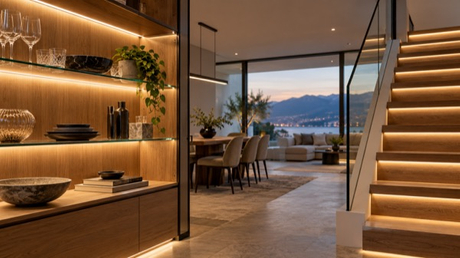
Direct answer: The best LED strip for cabinets, shelves or staircases is chosen from the complete installation: the visual task, viewing distance, available profile, voltage, cut length, wiring route, control method and exposure to heat or moisture. A strip that looks ideal on a sample board may perform poorly if the profile, diffuser, power feed or mounting surface is wrong. Specify the application first, then approve a representative assembly.
Who Is This LED Strip Application Guide For?
This guide is for lighting designers, millwork companies, kitchen and furniture manufacturers, electrical contractors, distributors and project buyers comparing low-voltage LED strip options for commercial and residential interiors. It focuses on three recurring tasks: lighting the inside of cabinets, creating an even shelf line and guiding movement on stairs.
Start With the Job of the Light
Cabinets: task light, display light or accent light?
Cabinet lighting may illuminate products, a work surface or only the cabinet interior. Task lighting usually needs controlled glare and a consistent line. Display lighting must protect finishes and colours from looking uneven. Accent lighting can prioritise a discreet profile and a comfortable viewing angle. Define the target before comparing wattage or LED density.
Shelves: a continuous line or focused beam?
Shelves are viewed from several angles, so the strip position and diffuser often matter more than the nominal strip brightness. A recessed aluminium profile can hide the LED image and protect the assembly. For glass or open shelves, check whether the line is visible from the front, side and below.
Staircases: visibility, orientation and maintenance
Stair lighting should help reveal tread edges without creating glare for people moving up or down. Decide whether the light is under the nosing, along the handrail, on the wall or in a side channel. The installation drawing should show access for cleaning, replacement and cable routing.
Choose the Optical System, Not Only the Strip
An LED strip is one component of an optical system. The aluminium profile, diffuser, distance from the illuminated surface and viewing angle determine how smoothly the line appears. A shallow profile, a wide diffuser or a closer mounting position can produce a different result from the same strip. Review the complete cross-section with a sample before approving a large project.
LED Strip or Silicone Neon Flex?
Flexible LED strip is useful when the project needs a slim, serviceable light source inside a profile or recess. Silicone neon flex can be preferable when the visible surface itself must read as a continuous luminous line or when a protected flexible body simplifies the outline. Confirm the bend direction, cross-section, mounting clips, end treatment and cable exit for the selected neon flex. Do not assume that a neon flex specification can be transferred to an LED strip installation.
Voltage, Run Length and the Wiring Route
The selected strip voltage must match the compatible driver and controller. For every cabinet bank, shelf run or stair section, record the run length, feed point, polarity, cable route and total connected load. Longer runs may require a defined feed strategy and a voltage-drop review. The decision should be based on the exact model and installation drawing, not on a generic maximum length.
Colour, CCT and Rendering Requirements
For kitchens, wardrobes, retail shelves and hospitality joinery, the target colour should be written into the specification. State whether the project needs a fixed CCT, tunable white, RGB or another colour configuration. If colour fidelity matters, define the required CRI and approve samples under the intended surrounding materials. Keep the selected production version and sample reference in the project record.
Dimming and Controls for Small Architectural Details
Cabinet, shelf and stair lighting is often controlled in zones. Confirm whether the system uses a low-voltage PWM controller, a compatible driver interface or a simple on/off circuit. Single-colour, tunable-white, RGB and RGBW configurations require different channel planning. Check low-end behaviour, flicker, scene recall and the location of the controller before finalising the wiring.
Thermal and Mounting Checks
LED strip performance depends on how heat leaves the assembly. Check whether the strip is mounted to an aluminium profile, a finished panel or another surface, and whether the adhesive or mechanical fixing is suitable for that surface. Avoid trapping a high-load strip in an enclosed cavity without reviewing the thermal path. A sample should be evaluated after the intended installation method is assembled.
Moisture and Cleaning Conditions
Indoor does not always mean dry. Kitchens, utility rooms, hotel bathrooms and display areas may involve steam, splashes or frequent cleaning. Select the protection level for the actual location and verify the complete assembly, including connectors, end caps, cable entries, profile and power supply. Cutting, joining or drilling can change the protection of the finished system.
How to Compare a Cabinet or Stair Lighting Sample
Compare samples at the intended viewing distance and in the intended profile or mounting position. Look for visible dots, dark zones at joints, glare on glossy surfaces, colour shifts and unwanted shadows. Test the actual control method and allow the assembly to reach a representative operating condition. Record the approved strip, profile, diffuser, connector method and cable exit.
Buyer Checklist for a Quotation
Application: cabinet, shelf, stair, handrail, display or another detail.
Drawing or cross-section showing the strip, profile, diffuser and viewing direction.
Voltage, colour or CCT, CRI target and colour-control configuration.
Run lengths, cut points, feed locations, cable-entry direction and quantity range.
Indoor, damp or splash exposure and the cleaning or maintenance method.
Driver, controller, dimming method, channel count and commissioning needs.
Required documents for the selected model and target market.
Frequently Asked Questions
What LED strip is best for cabinet lighting?
The best choice depends on the cabinet depth, viewing angle, profile, diffuser, colour target and control method. Approve the strip as a complete installed assembly.
Do shelves need an aluminium profile?
A profile can improve mounting, protection and heat transfer, while the diffuser can soften the LED image. The required profile should be confirmed from the cross-section and visual target.
Can one LED strip specification be used for every staircase?
No. Stair geometry, mounting position, viewing direction, run length and maintenance access change the correct design.
Is silicone neon flex better than LED strip for a visible line?
It can be a better fit when the visible surface must appear continuous or the outline needs a protected flexible body. Confirm bend direction and mounting details by model.
How do I avoid dots on a shelf or cabinet?
Review LED density, profile depth, diffuser, mounting distance and viewing angle together. A representative sample is more reliable than a strip-only photograph.
Can I cut and reconnect LED strip in a cabinet?
Only at the model’s defined cut points and with a connection method suitable for the assembly. Recheck polarity, mechanical strain relief and protection after joining.
What information should I send for a quotation?
Send the application, drawing, dimensions, voltage, colour or CCT, CRI, run lengths, control method, exposure conditions, quantity range and required documents.
Does a higher wattage always make a better stair light?
No. Glare, viewing comfort, profile optics, heat removal and control behaviour can matter more than nominal wattage.
Plan the Complete Installation With Leomay
Planning LED strip or silicone neon flex for cabinets, shelves, staircases or another application? Send Leomay the application, drawing, dimensions, voltage, colour or CCT, CRI, run lengths, control method, exposure conditions, quantity range, target market and required documentation. The suitable product options and document availability can then be reviewed for the selected model and project.