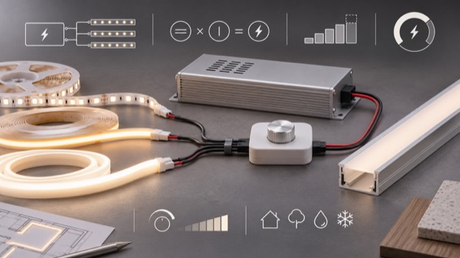
Direct answer:The right LED strip is selected from a complete specification, not one headline number. Confirm application, input voltage, watts per metre, LED density, colour or CCT, CRI, IP conditions, cut length, control method, profile, driver and termination together. A higher wattage, density or IP code is not automatically better; the correct choice is the model that fits the visual target, available space, thermal path, wiring plan and maintenance strategy.
This guide is for lighting designers, electrical engineers, distributors, sign makers, contractors and procurement teams comparing low-voltage LED strip options for commercial projects. It answers a practical buyer question: what do the numbers on an LED strip specification sheet mean, and which fields should be confirmed before quotation or sampling?
Indirect architectural lighting Coves, shelves, cabinets and recessed details require attention to visual continuity, profile depth, diffuser choice, viewing distance and heat removal. The strip is only one part of the final result. Visible linear features Reception details, signs, wayfinding and curved outlines may require a defined luminous surface or silicone neon flex. Confirm cross-section, bend direction, mounting hardware and cable exit before comparing price or wattage.
Input voltage must match the selected driver, controller and wiring architecture. A 12V strip is not a drop-in replacement for a 24V strip. Confirm the voltage printed on the exact model, driver output, polarity and controller range. For longer runs, also review 12V vs 24V LED strip selection and voltage drop and power supply sizing.
Watts per metre describes electrical demand, not brightness by itself. Two strips with similar wattage can look different because of LED package, optics, colour, efficiency, diffuser and thermal conditions. Calculate connected load from the exact model, run length, colour configuration and operating mode, then check driver capacity, controller channels, cable sizing and connector ratings.
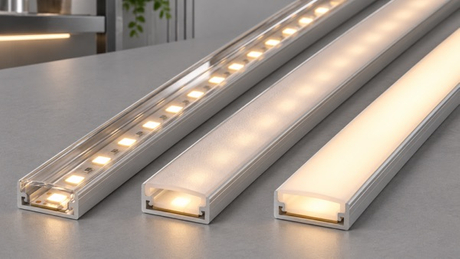
Density and cut interval influence how easily a strip fits a dimension and how visible individual points may appear through a diffuser. They do not guarantee a dotless result. Profile depth, cover type, viewing angle, mounting surface and distance all change the final appearance. Request the exact cut mark, cut interval, pad layout and minimum usable section.
Single-colour and tunable white Confirm whether the project needs one fixed CCT, tunable white, dim-to-warm or another configuration. Multi-channel strips require compatible control, channel wiring and commissioning. RGB, RGBW and RGBCCT Colour-changing strips require channel mapping and controller compatibility. The selected controller, power supply and wiring must support the exact channel count and desired white-light behaviour. Colour quality CRI, R9, TM-30 and SDCM describe different aspects of colour evaluation. Request test information for the exact model and operating condition. See the LED strip colour quality guide.
COB and SMD describe different light-source constructions. COB can reduce the appearance of discrete points, while SMD options may provide different density, power and colour configurations. Compare the actual sample inside the intended profile and diffuser rather than selecting from the acronym alone. Read the COB vs SMD commercial project guide.
An IP code addresses protection conditions for an enclosure; it does not automatically certify every part of an installed system. Evaluate cuts, connectors, end caps, cable entries, junctions, driver location, drainage, condensation, chemicals and mechanical exposure. Do not describe an IP-rated strip as permanently waterproof without confirming the test conditions and complete assembly. See the IP ratings guide.
Control is a system decision. Check whether the strip uses low-voltage PWM, a compatible driver interface, a digital protocol or another architecture. The protocol name alone does not prove compatibility: driver output, voltage, current, channel count, dimming behaviour and wiring must match. See the LED strip dimming and control guide.
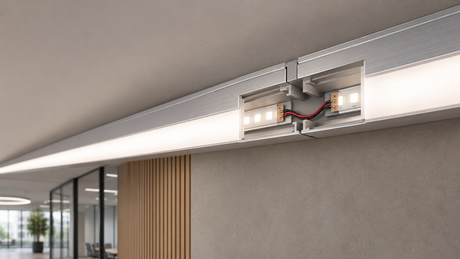
An aluminum profile can provide mounting, optical control and a heat path, but it does not automatically solve every thermal or visual issue. Confirm internal width, depth, diffuser position, mounting surface and service access. Review the thermal management guide for higher-power or long-running installations.
Ask whether the project will use soldered leads, approved connectors or factory-prepared sections. Confirm polarity, connector width, strain relief, cable-exit direction, end-cap method and access to field joints. For neon flex, the cut mark, bend direction and end-cap process are especially important; review the neon flex cut and termination guide.
| Project question | First specification to verify |
|---|---|
| Will the source be seen? | Optical construction, density, profile, diffuser and viewing distance |
| Is the run long or split? | Voltage, watts per metre, current, feed points and driver position |
| Does colour change? | CCT or colour configuration, channel count and controller compatibility |
| Is the location damp or outdoors? | Specified IP conditions and protection of every termination |
| Will the strip be cut on site? | Cut interval, pad layout, connector/end-cap method and service access |
Separate confirmed model data from marketing language. Look for exact model code, voltage, power basis, colour or CCT, density, board width, cut interval, protection conditions, control method, test notes and document revision. If a value is absent, ask rather than infer it from a similar product. UL, CE, RoHS or FCC documentation availability must be confirmed for the applicable model and destination market.
A representative sample should reproduce the real decision: selected strip, profile, diffuser, driver, controller, cable, cut, termination, mounting surface, viewing distance and operating mode. Check visual effect, start-up, low-end dimming, colour consistency, temperature, joints and maintenance access. Record the approved model and revision so later substitutions can be reviewed.
There is no single universal field. Start with application, voltage, optical effect and dimensions, then confirm power, colour, control, protection and termination as one system.
No. Density can influence visual continuity and cut flexibility, but the result also depends on optics, profile, diffuser, viewing distance, power and thermal conditions.
Compare exact voltage, driver, current, run layout, feed points and control hardware. Do not replace one voltage with the other without checking the complete electrical design.
Not by itself. Wattage describes electrical demand. Brightness also depends on LED construction, efficiency, colour, optics, thermal conditions and measurement method.
No. Confirm specified test conditions and protect cuts, connectors, end caps, cable entries, joints, driver and controller. Drainage, UV, chemicals and temperature also matter.
No. The dimmer, driver, controller, voltage, current, channels and wiring must be compatible. A mains-side dimmer cannot connect directly to a low-voltage DC strip.
Include the selected strip, profile, diffuser, driver, controller, mounting method, representative cut and termination, plus intended viewing and environmental conditions.
Send the application, drawing or photos, viewing distance, dimensions, voltage, power target, CCT or colour, CRI requirement, control method, run lengths, environment, cut and termination needs, target market, quantity range and required documents.
Planning an LED strip, COB strip or silicone neon flex project? Send Leomay the application, installation drawing or photos, available dimensions, viewing condition, voltage, colour or CCT, CRI requirement, control method, run lengths, profile or diffuser requirement, environment, cut and termination method, quantity range, target market and required documentation. Leomay can review relevant options for the selected model and project. Documentation availability must be confirmed for the selected model and destination market.